

Reviewed · OMO VALLEY TRIBE TOURS
Omo Valley 5 Day Tour
Culture takes center stage here. This five-day journey from Addis Ababa reaches some of southern Ethiopia’s most distinctive communities, from Dorze weavers and Konso terrace farmers to the Mursi, Hamer, Karo, and Dasenech people. I especially like the wide range of cultural visits packed into a short trip, and the chance to see both daily life and ceremonial traditions. The company’s service is also praised for being friendly, professional, and well organized.
The main consideration is the pace. Each touring day is listed at about 12 hours, with long drives, early breakfasts, and several major stops. You should book this trip for cultural discovery rather than easy relaxation. The $1,450 price includes flights within Ethiopia, four nights of accommodation, meals listed, transport, guides, and park-related support, but personal expenses and tips are extra.
In This Review
- Key points to know before you book
- Why this southern Ethiopia route is worth your time
- Day 1: Chencha and the Dorze people
- Day 2: Konso terraces and the Mursi of Mago National Park
- Day 3: Turmi, Hamer culture, and the chance of a market
- Day 4: Karo body painting and the Omo River crossing
- Day 5: Returning through Arba Minch to Addis Ababa
- What the $1,450 price covers
- Practical points for a smoother trip
- Who will enjoy this Omo Valley tour most?
- Should you book the five-day Omo Valley tour?
- FAQ
- Where does the Omo Valley tour start?
- How long is the tour?
- Are domestic flights included?
- Which communities does the tour visit?
- Is the Hamer bull-jumping ceremony guaranteed?
- What is included in the price?
Key points to know before you book

- Six distinct cultural encounters: Meet the Dorze, Konso, Mursi, Hamer, Karo, and Dasenech communities across southern Ethiopia.
- Two domestic flights: You fly from Addis Ababa to Arba Minch at the start and return there for the flight back to Addis on Day 5.
- Long but full touring days: The schedule gives each day about 12 hours, so this is an active road trip, not a slow-paced hotel holiday.
- Important market days: The Hamer market visit is possible when the schedule falls on Saturday, Tuesday, or Thursday.
- Small maximum group: The tour accepts no more than 15 people, which can make vehicle travel and local visits more manageable.
- Flexible food arrangements: Vegetarian, vegan, gluten-free, and other dietary needs can be accommodated when arranged.
Why this southern Ethiopia route is worth your time
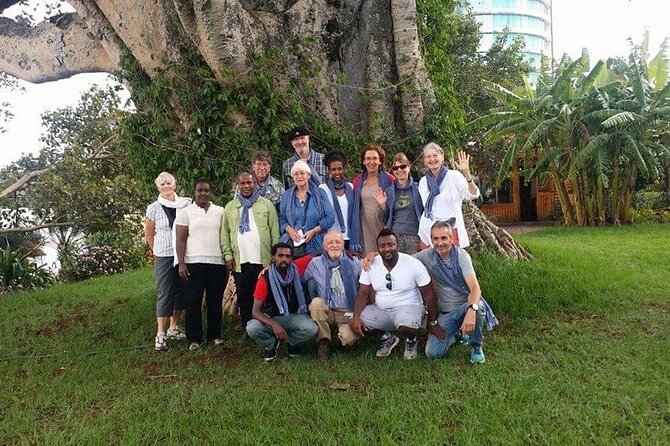
The Omo Valley is not a single attraction. It is a broad region where languages, clothing, farming methods, body decoration, ceremonies, and village traditions change from one community to the next. This tour gives you a quick but wide-ranging look at that variety.
I like the route because it does not rely on one famous stop. You begin with Dorze weaving culture, continue to the UNESCO-listed Konso area, then reach Mago National Park and the communities around Turmi, Murulle, and Omorate. Every day adds a different setting and a different cultural subject.
You should also keep your expectations sensible. A five-day schedule can introduce you to several places, but it cannot provide a complete understanding of each community. The value lies in the range of encounters and the local guiding, not in spending several days in one village.
The tour includes local guides and a scout where needed. That matters in the Omo Valley, where local context can help explain what you are seeing and how to behave respectfully. The strongest praise for Simen Land Tours focuses on professional organization, friendly service, and guides who make the trip educational as well as enjoyable.
More Omo Valley Tribe Tours in Addis Ababa
- 6 Days Omo Valley Tribes Tours From Addis Ababa
★ 5.0 · 33 reviews - 3 Days Omo Valley Tour
★ 5.0 · 24 reviews - Danakil Depression, Lalibela, Omo Valley and Simien Mountains
★ 5.0 · 23 reviews
Day 1: Chencha and the Dorze people
Your first day begins with a transfer to the airport and a flight to Arba Minch. From there, you meet your driver and continue to Chencha, home of the Dorze people.
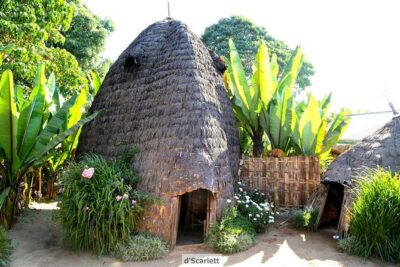
The Dorze are known for weaving, and you will see how that skill shapes more than clothing. Their cotton garments, fences, and distinctive beehive-shaped bamboo huts all reflect local craft traditions. This makes Chencha a useful first stop because you are introduced to culture through objects you can see and understand, rather than through a rushed performance.
I particularly like the focus on weaving. Textiles show how art and daily life overlap, and the Dorze visit gives you a chance to connect clothing and household design with the people who make them. The huts are another visual highlight, with their unusual form giving the visit a strong sense of place.
The day is listed at approximately 12 hours, including the flight, road transfer, and Chencha visit. That is a long opening day, especially after an early departure, so pack lightly and keep essentials close in the vehicle. The tour includes an air-conditioned vehicle, which should make the road portions more comfortable.
Admission tickets are included in the tour arrangements, and accommodation begins with this four-night land program. Breakfast is included throughout the five-day schedule. The exact hotel names are not provided, so you should ask the operator for those details before booking if accommodation standards matter to you.
Day 2: Konso terraces and the Mursi of Mago National Park
Day 2 begins with an early breakfast and a drive to Konso village. The Konso area is a UNESCO site, and the visit focuses on the Konso people and their terraces.
The terraces are important because they show how communities have shaped steep or difficult ground for farming. Here, the physical setting is part of the cultural story. You are not simply looking at old buildings or a museum display. You are seeing how local knowledge has influenced settlement and agriculture.
After Konso, the route continues to Mago National Park and a visit with the Mursi. The tour description highlights the lip plates worn by some Mursi women after a coming-of-age practice. This is one of the most recognizable customs associated with the region, but it deserves a respectful approach. You are looking at a cultural tradition, not a spectacle designed for outside approval.
The schedule may also allow an afternoon visit to an Ari village. The wording matters: this stop depends on available time. Since the day already includes Konso, the road journey, Mago National Park, and the Mursi visit, you should treat the Ari visit as an extra possibility rather than a guaranteed part of the day.
This is another 12-hour day. The distance and number of stops make it one of the more demanding parts of the route. The reward is variety: agricultural terraces in the morning, a national park setting later, and two possible cultural visits before the day ends.
Day 3: Turmi, Hamer culture, and the chance of a market

After breakfast, you drive to Turmi, the settlement associated with the Hamer people. If this day falls on Saturday, Tuesday, or Thursday, the route may include a local tribal market.
The market is a useful addition because it can show ordinary exchange and community life alongside the more formal village visit. The timing is crucial, so check your dates before you book if the market is a priority. On other days, the schedule focuses on the Hamer village.
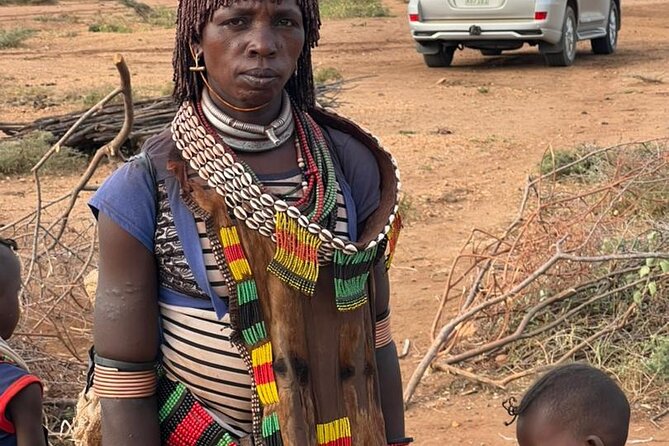
Hamer clothing and adornment are among the most memorable parts of this stop. The women are described as wearing thick plaits colored with ochre, leather skirts decorated with cowries, and numerous copper bracelets. These details are not minor decoration. They communicate identity, age, status, and connection to local custom.
The Hamer are also associated with bull jumping, a male initiation ceremony. The tour makes clear that seeing it is a matter of chance. You should not book this trip expecting a guaranteed ceremony. If one happens during your visit, it is an unusual opportunity, but the village visit itself remains the dependable part of the day.
I appreciate that the schedule does not promise a ritual it cannot control. Ceremonies occur according to local circumstances, not a tourist timetable. That uncertainty is part of the reality of cultural travel, although it may disappoint anyone hoping for a fixed show.
With another 12-hour touring day, you will want to keep water, sun protection, and personal necessities within easy reach. The tour includes an air-conditioned vehicle, but the long road transfers still make this an active trip.
A different sort of day out, same part of Ethiopia:
- Full Day Tour of Addis Ababa with Hotel Pickup and Drop-off
★ 5.0 · 430 reviews - Taste of Ethiopia
★ 5.0 · 406 reviews - Day Trip From Addis Ababa See Historical Monastery,Stunning Nature,Animals,Birds
★ 5.0 · 303 reviews - Addis Ababa: Debre Libanos, Blue Nile Gorge, and Cave Tour
★ 4.5 · 256 reviews
Day 4: Karo body painting and the Omo River crossing
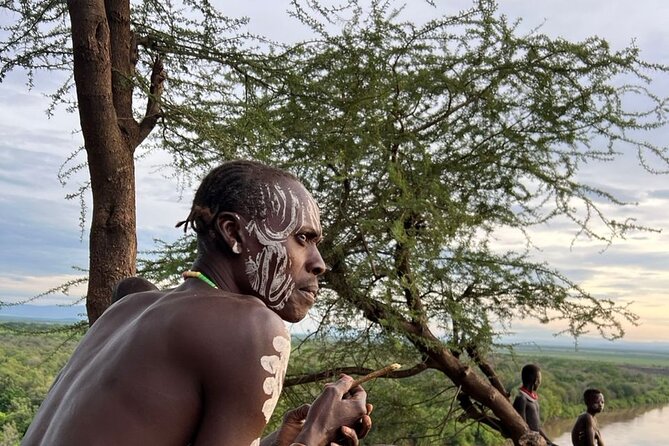
Day 4 starts from Turmi with an excursion to Murulle, the village of the Karo people. The Karo are described as one of the region’s smallest ethnic groups, and they are known for painted body and face decorations used before important ceremonies.
This visit offers a different focus from the Hamer stop. At Chencha, the emphasis is on weaving and architecture. At Konso, it is on terraces and settlement. Among the Karo, symbolic body and face painting take center stage. That contrast gives the overall tour its strength.
The afternoon brings a trip to Omorate and a boat crossing of the Omo River to visit the Dasenech people. The Dasenech are noted for body scarification, another form of physical decoration connected with identity and tradition.
The river crossing adds a change of pace after several road-based visits. It also helps you understand how geography affects daily life in the region. The Omo is not simply scenery here. It is part of the route and a connection between communities.
You should remember that this remains a tightly packed day. Murulle and Omorate are separate excursions, and the tour still lists the day at about 12 hours. The boat crossing is included in the planned experience, but details such as boat size, crossing duration, and weather procedures are not specified, so ask Simen Land Tours if those points are important to you.
Day 5: Returning through Arba Minch to Addis Ababa

The final day begins with an early breakfast and the drive back to Arba Minch. From there, you take the flight back to Addis Ababa and make your own way from the airport to your destination.
This is mainly a travel day, not another major cultural visit. That is worth knowing when you compare the five-day duration with the number of included touring days. The first four days carry the cultural program, while Day 5 gets you back to the capital.
The return flight is useful because it avoids repeating the long road journey to Addis Ababa. It also gives the tour a clear ending, although you should plan your onward arrangements with enough time after arrival. The tour says you make your way to your own place once back in Addis, so that final transfer is not described as included.
What the $1,450 price covers

At $1,450 per person, this tour is not a bare road trip. The price includes the domestic flights at the beginning and end, four nights of accommodation, an air-conditioned vehicle, local guides, a scout where needed, all fees and taxes, and five breakfasts.
That package gives the price real value, especially because domestic flights and a private touring vehicle can add a large amount to a southern Ethiopia trip when arranged separately. You also avoid having to coordinate several drivers, local visits, park arrangements, and the return flight on your own.
The package does not include personal expenses or tips. Plan for those separately. The tour also says that if a miscellaneous adventure activity requires special equipment, the operator will try to accommodate it at its own cost. That is a generous policy, but it is not a promise of unlimited optional activities.
The group maximum is 15 people. That is small enough to keep the vehicle group from becoming unwieldy, though your exact group size may be smaller or close to that limit. A smaller group can also make it easier to hear the guide and stay together during village and park visits.
Practical points for a smoother trip

The listed start time is 9:00 a.m., but several days call for early breakfast or early travel. Confirm the exact pickup time and airport arrangements with the operator before departure.
Pickup is offered, and confirmation is provided at booking. Mobile tickets are available, which is useful when you are managing flight and road details during a busy trip.
Dietary restrictions can be accommodated, including vegetarian, vegan, and gluten-free diets. Tell the company in advance rather than waiting until you arrive.
Most people can participate, according to the provided tour information. Still, the repeated 12-hour days and long drives mean you should be comfortable with an active schedule. The information does not provide specific accessibility details, so ask directly if you have mobility or medical concerns.
Free cancellation is available if you cancel at least 24 hours before the local start time. Cancellations made inside that window are not refunded, and late changes are not accepted.
Who will enjoy this Omo Valley tour most?
I would recommend this trip to you if you want a concentrated introduction to southern Ethiopia’s cultural groups and prefer having transport, flights, accommodation, and local support arranged together.
It suits people who enjoy early starts, long road journeys, photography, traditional clothing, village life, and cultural interpretation. It is also a good fit if you want to see several communities but have only five days available.
You may want a slower trip if you prefer long stays, quiet afternoons, or extensive time with one community. You should also understand that famous ceremonies, including Hamer bull jumping, are not guaranteed. The cultural value comes from the overall route, not from checking off one dramatic event.
The two available ratings give the company a perfect overall score, with praise for professional, friendly service and an educational experience. That is encouraging, though the small number of ratings means I would still ask practical questions about hotels, vehicle arrangements, and the exact domestic flight schedule before paying.
Should you book the five-day Omo Valley tour?
Book it if your priority is variety and convenience. In five days, you can see Dorze weaving traditions, Konso terraces, Mursi customs, Hamer adornment, Karo body painting, and Dasenech scarification, with flights helping limit the longest transfers.
Skip it if the pace sounds tiring or you want guaranteed access to a ceremony. This is a full cultural road trip with several 12-hour days, not a gentle sightseeing break.
For the right person, the $1,450 cost is reasonable because it brings together transport, four nights of accommodation, meals listed, guides, and a carefully connected route. Go with curiosity, patience, and respect, and this can be a powerful first look at southern Ethiopia.
FAQ
Where does the Omo Valley tour start?
The tour is based in Addis Ababa, with pickup offered. The listed start time is 9:00 a.m.
How long is the tour?
The tour lasts approximately five days. Each itinerary day is listed at about 12 hours.
Are domestic flights included?
Yes. The tour includes a flight from Addis Ababa to Arba Minch at the beginning and a return flight from Arba Minch to Addis Ababa on Day 5.
Which communities does the tour visit?
The route includes visits connected with the Dorze, Konso, Mursi, Hamer, Karo, and Dasenech people.
Is the Hamer bull-jumping ceremony guaranteed?
No. The ceremony is described as a matter of chance. A local market visit is also dependent on the day being Saturday, Tuesday, or Thursday.
What is included in the price?
The price includes an air-conditioned vehicle, fees and taxes, four nights of accommodation, local guides and a scout where needed, five breakfasts, and the listed domestic flights. Personal expenses and tips are not included.
New on the Addis Ababa list
- Yod Abyssinia Cultural Night: Dinner, Music, and Dance★ 5.0 · 7 reviews
- Locally crafted beer and wine tasting and nightlife in Addis tour★ 5.0 · 6 reviews
- Addis Ababa City Tours Full-Day Tours★ 5.0 · 5 reviews
- Stunning Views Wonchi Crater Lake a Private Day Trip★ 5.0 · 3 reviews
- Visiting the wonders of Lalibela in Three (3) days and Two ( 2) nights★ 5.0 · 2 reviews
- Unique Ethiopian Cooking Class and Coffee Ceremony with a Local in Addis Ababa★ 4.5 · 7 reviews
- Tribes of the Ethiopian Omo Valley – 9 Day Tour★ 5.0 · 5 reviews
- Two days Lake Wenchi and Menagesha Forest★ 5.0 · 3 reviews
Omo Valley Tribe Tours, compared.
6 Days Omo Valley Tribes Tours From Addis Ababa
Read our review →
Lalibela, Axum, Danakil and Omo Valley 8 DAYS
Read our review →

3 days around Arbaminch and Konso Adventure Tours Life Time
Read our review →Danakil Depression, Lalibela, Omo Valley and Simien Mountains
Read our review →

Browse the lists this tour appears in