Reviewed · ROCK-HEWN CHURCH TOURS
8 Days Lalibela,Danakil Depression and Omo Vally Tours
Earth gets strange here. This $1,199 eight-day tour links three very different parts of Ethiopia: the sulfur colors and salt plains of the Danakil Depression, Lalibela’s carved churches, and the Omo Valley communities around Turmi, Jinka, and Mago National Park. I like the way the trip uses domestic flights to cover huge distances, and I like the small maximum group size of 15 people, which should make airport transfers and guided visits easier to manage. The main drawback is the pace: early starts, rough road sections, hot camps, and several flights leave little room for delays or rest.
The strongest part of the plan is its range. You can watch the sun set near Lake Assale, climb toward Erta Ale, stand among Lalibela’s underground churches, and then meet Hamer, Kara, and Mursi communities in the south. The organization also receives especially warm praise for staff members such as Mickey, who is described as patient, helpful, and available when plans need attention. Before paying, I would ask the company to confirm a few unclear times in the written schedule, especially on Day 2 and the repeated Day 5 and Day 6 description.
In This Review
- Key points before you book
- Is $1,199 good value for eight demanding days?
- Day 1: From Semera to Dallol and Lake Assale
- Day 2: Dallol at sunrise and the climb toward Erta Ale
- Day 3: Sunrise at Erta Ale and the return to Addis Ababa
- Day 4: Lalibela’s underground churches
- Day 5 and Day 6: Jinka, Turmi, and the Hamer community
- Day 7: Kara village and the road back to Jinka
- Day 8: Mago National Park and the Mursi visit
- What the schedule means for you
- Who should book this Ethiopia tour?
- Should you book it?
- FAQ
- How long is the tour?
- Where does the tour start and end?
- Is airport pickup offered?
- How many people can join the tour?
- What level of fitness is required?
- Does the tour include Lalibela’s rock-hewn churches?
- Can I cancel for a full refund?
Key points before you book
- Danakil includes both Dallol and Erta Ale: You see sulfur and salt formations, Lake Assale, a salt lake near Afdera, and an active volcano.
- The schedule is built around flights: Flights connect Addis Ababa with Semera, Lalibela, and Jinka, saving long overland journeys.
- Expect very early mornings: Wake-up times of 4:30 a.m. appear on several Danakil days, with more early departures in the Omo Valley.
- Lalibela brings a major change of mood: The trip moves from volcanic heat and desert emptiness to Ethiopia’s famous rock-hewn churches.
- The Omo Valley visits are community-focused: The route includes Hamer, Kara, and Mursi villages, with camping and lodge accommodation.
- The group is capped at 15: That is a useful size for a demanding multi-stop trip, though the exact group size may vary.
Is $1,199 good value for eight demanding days?
At $1,199 per person, this is not a cheap city break, but the price covers a lot of ground in a short time. The plan includes airport pickup, domestic flights between major regions, road transfers, guides, accommodation, camping in the Danakil, and visits to several well-known sites.
That matters in Ethiopia because these regions are far apart. Reaching the Danakil, Lalibela, and the Omo Valley independently would require arranging several flights, vehicles, local guides, and overnight stays. The tour also handles the practical handoffs between airports and drivers, which is one of the main reasons to choose an organized trip here.
The value depends on what you want. If your priority is seeing the country’s major sights in one compact trip, the price looks sensible. If you prefer slow mornings, long stays, and time to explore one region properly, this itinerary may feel rushed.
Several people who used Danakil Depression Tours praised the organization, accommodation, food, and personal support. Mickey receives repeated praise for meeting people, helping with hotel arrangements, and staying available during the trip. Other staff members named in positive feedback include Althaf, Abey, Robel, and Dangnachee. Since staff assignments can change, ask who will manage your particular departure.
More Danakil Depression Tours in Addis Ababa
- 12 Days SIMIEN MOUNTAIN-LALIBELA-DANAKIL-TIGRAY CHURCHES
★ 5.0 · 45 reviews - 3 Day Danakil Depression Ertale and Dallol Tours
★ 5.0 · 44 reviews - 3 Days Dankile Depression group Tours
★ 5.0 · 40 reviews
Day 1: From Semera to Dallol and Lake Assale
The tour begins with a 7 a.m. ET 110 flight from Addis Ababa’s Bole Airport to Semera, scheduled to arrive at 8:30 a.m. From there, a vehicle takes you toward Hamed Ela, the base village for the Dallol area.
The drive passes Afdera Lake, a salt lake where the group stops for about 40 minutes and eats lunch. This is a useful break before the rougher and more remote section of the journey. The arrival at Dallol is planned for around 3:30 p.m., followed by an hour at camp.
Dallol is the visual star of the first day. The area is known for sulfur colors, salt formations, and mineral-stained ground that can look almost unreal. You may visit Dallol after the camp break or drive to Lake Assale for sunset. The final return to Hamed Ela is scheduled for around 7:30 p.m.
The practical issue is heat and exposure. This is one of the hottest places on Earth, and the schedule places you outside in the afternoon. You need to be comfortable with heat, dust, basic camping conditions, and a long vehicle journey before you even reach the main sights.
Day 2: Dallol at sunrise and the climb toward Erta Ale
Day 2 begins at 4:30 a.m. for another visit to Dallol. The early hour is worthwhile because the light changes the colors and textures, and the cooler conditions are easier on your body.
After about a 30-minute drive, breakfast is planned near the salt cannon at 9 a.m. You then spend time in the area until 11:30 a.m. before driving toward Erta Ale, an active volcano.
The schedule describes about three hours of driving to the Erta Ale campsite. It then allows time for a break and sunset photographs before the walk to the rim at 4:15 p.m. The walk is listed as about one hour each way, with time at the top and a return to camp around 9 p.m., followed by dinner.
One timing detail needs clarification. The written plan says the group reaches the Erta Ale campsite at 2:30 a.m., which does not fit the sequence of an 11:30 a.m. departure and a three-hour drive. It likely means 2:30 p.m., but confirm this before booking.
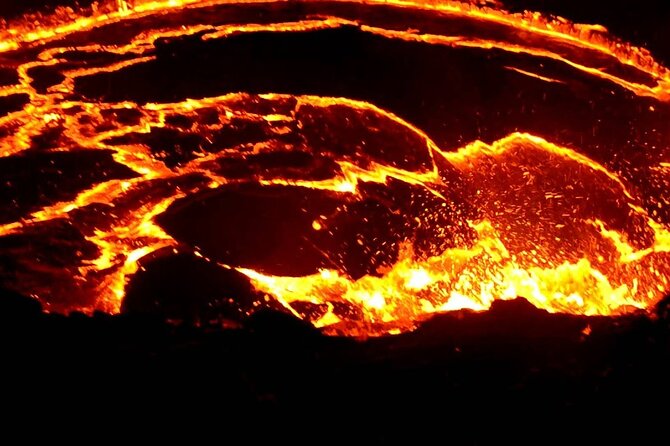
Erta Ale is the physical high point of the trip. You are not simply driven to a viewpoint. You walk for about an hour toward the rim, then spend the evening near an active volcanic area. The sunset and sunrise views are described as notably different, so the overnight stay earns its place in the itinerary.
Do not treat this as a comfortable resort excursion. The combination of heat, limited sleep, walking, and remote conditions is exactly what makes the Danakil memorable, but it also makes the trip unsuitable for anyone seeking an easy holiday.
Day 3: Sunrise at Erta Ale and the return to Addis Ababa
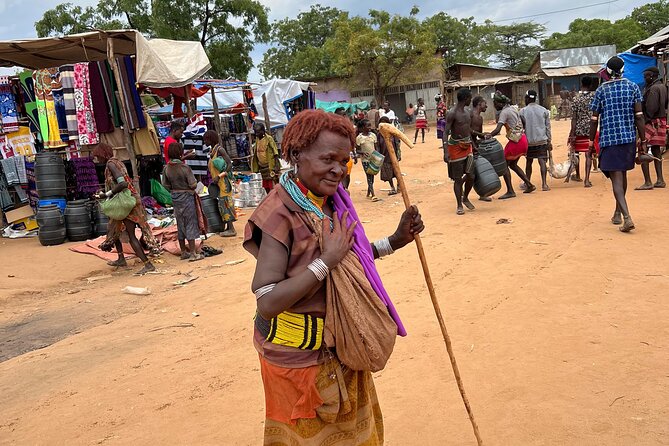
Another 4:30 a.m. wake-up gives you time to watch sunrise at the volcano. The morning light provides a different view from the previous evening, and the plan keeps you at the site until about 9 a.m.
After breakfast at around 10:30 a.m., you begin the five-hour drive back toward Semera via Afdera Lake. The scheduled ET165 flight leaves at 5:40 p.m. and arrives in Addis Ababa around 6:40 p.m.
This is a long day, and the flight connection matters. The five-hour road transfer leaves some planned time before departure, but remote roads can make any airport schedule feel tight. You should confirm how the operator handles a delayed flight or a late vehicle, even though the itinerary is designed to connect the two.
You spend the night in Addis before flying north to Lalibela. That overnight stop breaks up the route and gives you a chance to sleep in a proper hotel after the Danakil camp.
More Omo Valley Tribe Tours in Addis Ababa
- 6 Days Omo Valley Tribes Tours From Addis Ababa
★ 5.0 · 33 reviews - 3 Days Omo Valley Tour
★ 5.0 · 24 reviews - Danakil Depression, Lalibela, Omo Valley and Simien Mountains
★ 5.0 · 23 reviews - 6 Days Lalibela, Omo Valley and Harar
★ 5.0 · 15 reviews
Day 4: Lalibela’s underground churches
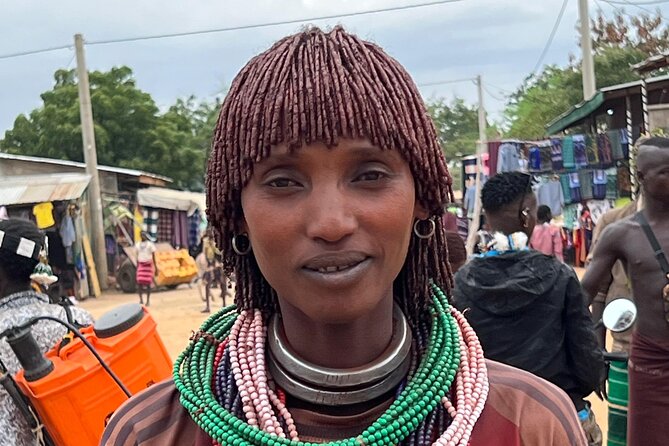
The next morning, you fly to Lalibela, where a representative meets you and transfers you to your hotel. In the afternoon, the tour visits the main church complex.
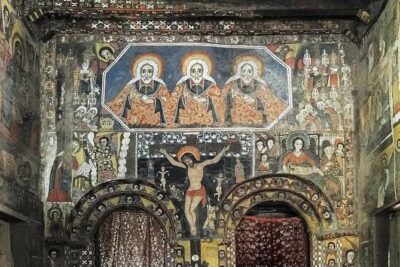
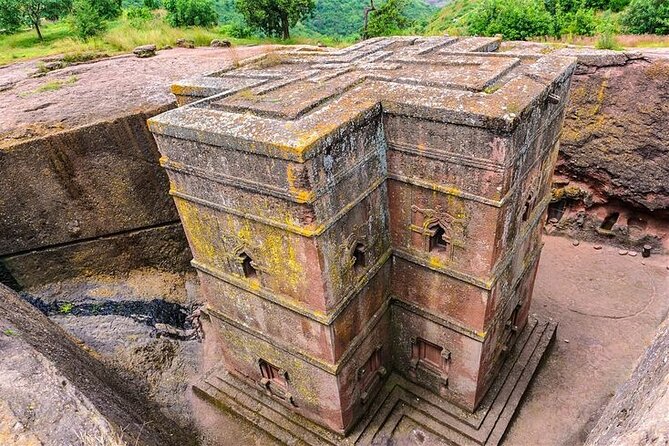
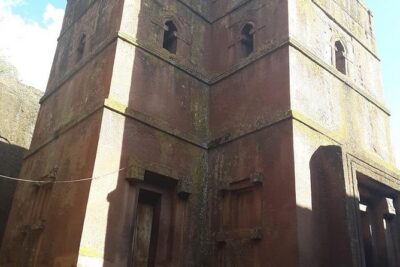
Lalibela is famous for churches cut directly into the rock. The listed stops include Bete Medhane Alem, Bete Mariam, Bete Meskal, Bete Denaghel, Bete Golgotha, Bete Mikael, and Bete Giorgis. The contrast with the Danakil is dramatic: after salt, sulfur, and volcanic heat, you are walking through a sacred architectural site with a very different sense of time.
You should expect a full afternoon rather than a quick photo stop. The churches are not a single building, and the names can blur together without a guide who explains how they relate to one another. The tour’s positive feedback places strong emphasis on guides and tour managers, so this is one part of the journey where good local explanation can make a major difference.
The schedule says Lalibela is visited on Day 4, then the next day heading to Jinka and Turmi is also labeled Lalibela. That appears to be a formatting error rather than an extra Lalibela day. Ask the operator to confirm the exact flight date and time from Lalibela to Jinka.
Day 5 and Day 6: Jinka, Turmi, and the Hamer community
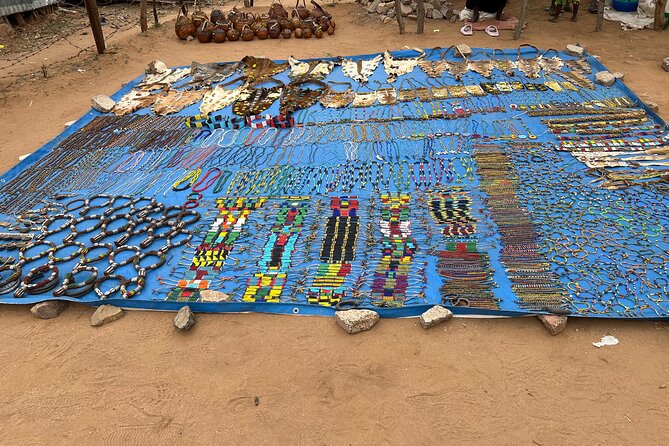
The southern section begins with an afternoon flight to Jinka. After meeting your guide and driver, you head directly to Turmi, an area associated with the Hamer people in the southeastern Omo Valley.
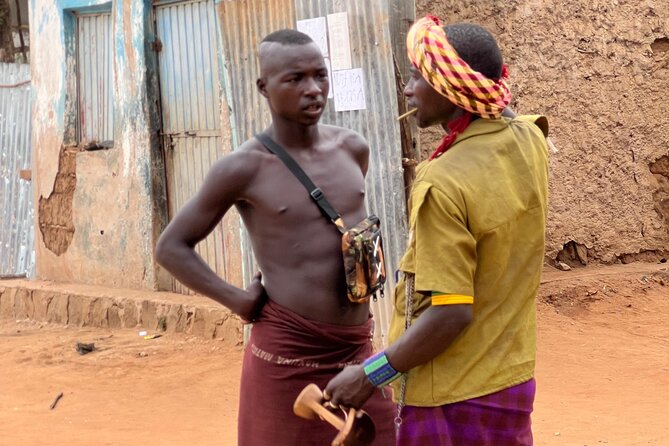
The Hamer are described through their grooming and adornment. Hair coloring, body oil, beads, and bracelets are important parts of the visual culture you will see. The plan takes you to a local Hamer village for a longer visit, followed by an overnight stay either camping at the village or at Buska Lodge, depending on which version of the schedule applies.
That accommodation difference is worth sorting out before departure. One day describes camping with the Hamer community, while the following version names Buska Lodge. These are very different nights. Camping offers a more basic and direct experience, while a lodge provides a more settled base after a long drive.
The drive from Jinka to Turmi is another reason to prepare for a demanding schedule. The plan allocates about eight hours to this day, so much of the experience is travel by road, not simply time in the village. That is not wasted time, since it connects remote places, but you should not expect a full day of relaxed cultural visits.
The Hamer visit also calls for a respectful attitude. You are entering a living community, not a museum display. Follow the guide’s direction, give people space, and treat photographs as a matter for permission rather than an automatic part of the experience.
Day 7: Kara village and the road back to Jinka
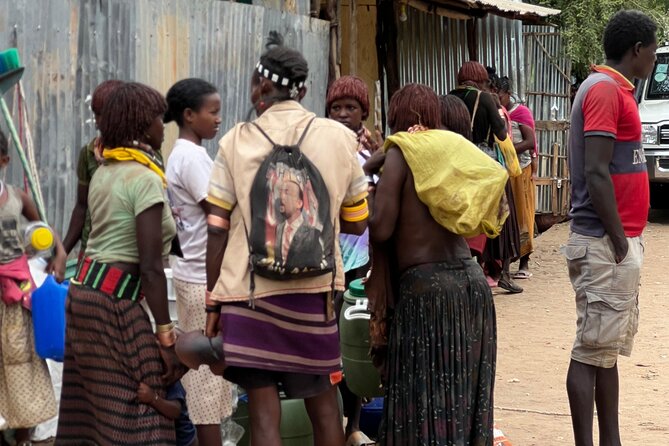
The day begins early with a drive to a Kara village on the west bank of the Omo River. The Kara are described as a small population of about 3,000 people, known for body painting used for personal decoration.
The destination is Dus, described as one of the more distant and less frequently visited Kara villages. Reaching it adds time on the road, but that remoteness is the point. The visit is designed to give you contact with a community that sees fewer organized groups than the better-known stops.
The schedule then takes you back toward Jinka, with a further visit planned along the way to a large and colorful local event or community setting. The supplied description cuts off before giving the full details, so ask for the exact stop and expected timing.
This day has the strongest promise for people who want a less familiar Omo Valley route. It also carries the greatest uncertainty because the final portion of the description is incomplete. Get the full Day 7 plan in writing, including the overnight location and whether meals are included.
Day 8: Mago National Park and the Mursi visit
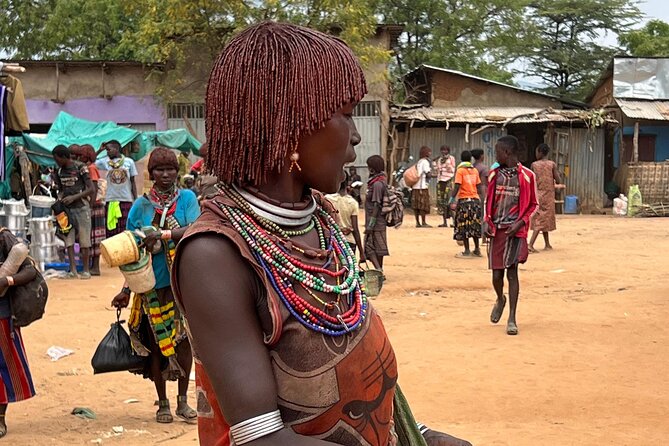
The last morning starts early with a drive of about 70 kilometers to the Mursi communities inside Mago National Park. The Mursi are widely associated with the lip plates worn by some women after reaching maturity, a custom described in the tour information.
The visit is intended to give you time in a Mursi village and a chance to share experiences with local people before returning to Jinka for the flight back to Addis Ababa. With another seven-hour day on the schedule, this is not a gentle final morning. You will need to leave early, spend time on the road, visit the village, and still make the flight.
The Mursi stop is likely to be powerful, but it is also the point where cultural sensitivity matters most. The description presents the lip plates as a defining custom, yet the people you meet are not attractions. Listen to your guide, behave calmly, and avoid reducing an entire community to one visual tradition.
The tour ends after the flight to Addis Ababa. The supplied meeting information lists Edna Mall on Cameroon Street as the start and end point, with a stated start time of 9 a.m. The first Danakil flight, however, is listed at 7 a.m., so confirm whether the airport transfer begins earlier than the general meeting time.
What the schedule means for you
This is a high-output itinerary. You cover three major regions by air and vehicle, with several long drives and early starts. The Danakil section includes camping, the Lalibela section includes sustained sightseeing, and the Omo Valley section includes rougher road travel and village visits.
A moderate level of physical fitness is required. The main physical demands are the one-hour walk toward Erta Ale, repeated early wake-ups, heat, extended time in vehicles, and the general strain of moving between remote areas.
A group maximum of 15 is a useful compromise. You get the support of an organized trip without the scale of a large coach tour. Still, ask how many people are expected on your date, since 15 and 6 create very different experiences at camps, airports, and village visits.
The operator receives especially strong praise for personal care and coordination. Mickey is repeatedly singled out for being helpful, smiling, and available, while other feedback praises airport pickup, hotels, food, and the way the northern and southern sections were joined together. Those details matter on a trip with this many moving parts.
Who should book this Ethiopia tour?
I would choose this tour if you want a broad first look at Ethiopia and accept that convenience comes through organization rather than a slow pace. It suits you if Danakil’s extremes, Lalibela’s churches, and Omo Valley cultural visits all rank high on your list.
It is less suitable if you dislike camping, heat, long drives, early mornings, or uncertain road timing. It is also not the right choice if you want several days in one region, since the itinerary keeps moving.
The cancellation terms are reasonable: you can cancel up to 24 hours before the start for a full refund, although changes made inside that period are not accepted. The experience requires a minimum number of people, so the company may offer another date or a full refund if that minimum is not met.
Should you book it?
Book this tour if range matters more to you than rest. For $1,199, you get an ambitious route through Ethiopia’s far north, historic highlands, and southern Omo Valley, with flights and local support doing much of the hard work.
Before booking, confirm the Day 2 arrival time at Erta Ale, the Day 5 and Day 6 accommodation, the complete Day 7 schedule, and the airport pickup time for the 7 a.m. flight. If those details are clear and you have the stamina for the pace, this is a strong way to see several of Ethiopia’s most distinctive places in one carefully connected trip.
FAQ
How long is the tour?
The tour lasts approximately eight days and ends after the flight from Jinka back to Addis Ababa.
Where does the tour start and end?
The listed meeting point is Edna Mall on Cameroon Street in Addis Ababa. The activity ends back at the meeting point.
Is airport pickup offered?
Yes. Pickup is offered, and the itinerary includes airport transfers in Addis Ababa, Semera, Lalibela, and Jinka.
How many people can join the tour?
The maximum group size is 15 people.
What level of fitness is required?
A moderate level of physical fitness is recommended. The schedule includes long drives, early mornings, hot conditions, camping, and a walk of about one hour toward the Erta Ale rim.
Does the tour include Lalibela’s rock-hewn churches?
Yes. The Lalibela visit includes Bete Medhane Alem, Bete Mariam, Bete Meskal, Bete Denaghel, Bete Golgotha, Bete Mikael, and Bete Giorgis.
Can I cancel for a full refund?
Yes. You can cancel at least 24 hours before the experience start time for a full refund. Cancellations or changes made less than 24 hours before the start are not accepted.
More Rock-Hewn Church Tours in Addis Ababa
- 5 DAYS Lalibela, Axum, Tigray churches and Danakil
★ 5.0 · 34 reviews - Danakil Depression and Lalibela 5 Days Tours
★ 5.0 · 28 reviews - 5 DAYS Axum, Lalibela, Tigray churches and Danakil
★ 4.5 · 22 reviews - Lalibela 3 Days/ 2 Nights Tour package
★ 5.0 · 13 reviews
New on the Addis Ababa list
- Yod Abyssinia Cultural Night: Dinner, Music, and Dance★ 5.0 · 7 reviews
- Locally crafted beer and wine tasting and nightlife in Addis tour★ 5.0 · 6 reviews
- Addis Ababa City Tours Full-Day Tours★ 5.0 · 5 reviews
- Stunning Views Wonchi Crater Lake a Private Day Trip★ 5.0 · 3 reviews
- Visiting the wonders of Lalibela in Three (3) days and Two ( 2) nights★ 5.0 · 2 reviews
- Unique Ethiopian Cooking Class and Coffee Ceremony with a Local in Addis Ababa★ 4.5 · 7 reviews
- Tribes of the Ethiopian Omo Valley – 9 Day Tour★ 5.0 · 5 reviews
- Two days Lake Wenchi and Menagesha Forest★ 5.0 · 3 reviews
Rock-Hewn Church Tours, compared.
12 Days SIMIEN MOUNTAIN-LALIBELA-DANAKIL-TIGRAY CHURCHES
Read our review →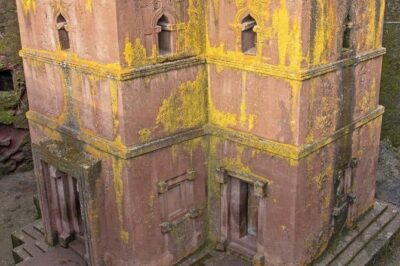
Tour 11 monolithic rock churches & museum in Lalibela & cave church with mummies
Read our review →
Ethiopia Tigray Tours: Guided tour of Tigray rock hewn churches
Read our review →
5 DAYS Lalibela, Axum, Tigray churches and Danakil
Read our review →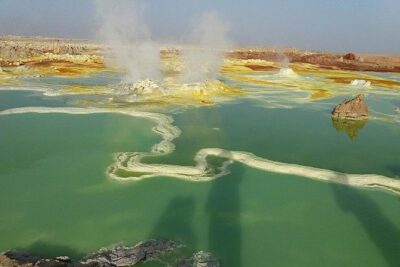
6 Days tour Package (Simien Mountains, Lalibela, and Danakil Depression)
Read our review →